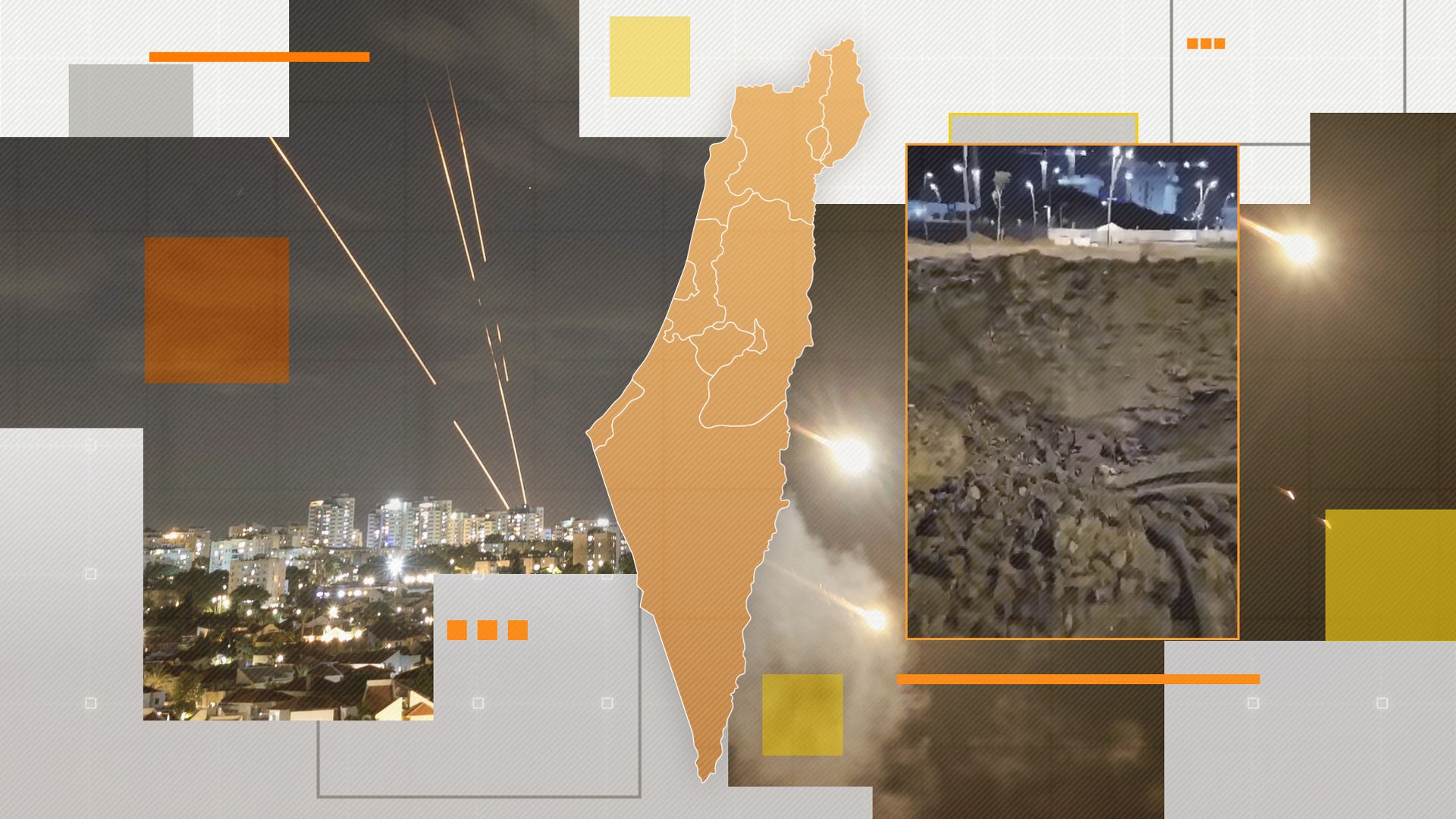
Iran launched nearly 200 missiles at Israel on Tuesday – many were intercepted by Israel’s air defence system, some landed in the sea, and others gouged craters in the earth.
Sky News’ Data and Forensics team looks at what we know about where the strikes were aimed, the damage they caused – and what could happen next.
At least seven impact locations have been identified by Sky News, including two Israeli airbases, a school grounds and two close to the area suspected of housing Mossad’s headquarters.
Iran said the attack was aimed at military bases and carried out in response to the assassinations of three prominent Iranian or Iranian-backed leaders – namely Ismail Haniyeh of Hamas, Hezbollah leader Hassan Nasrallah and Iranian Revolutionary Guard (IRGC) commander Abbas Nilforoushan.
Sky News has geolocated three videos that suggest the Nevatim airbase was targeted.
While none prove the base was directly hit, or what damage may have been caused, taken together they strongly suggest missiles landed within its perimeter.
In the footage viewed by Sky News, at least eight missiles were seen to have exploded in the direction of the base. The number of additional rockets visible suggest many more are likely to have impacted.
Nevatim airbase in the Negev desert, which houses Israel’s F-35 fighter jets, was targeted in Iran’s drone and missile barrage in April, carried out in response to an attack on the Iranian consulate in Damascus.
Missiles were also seen landing in the direction of Tel Nof airbase.
The headquarters of the Israeli intelligence agency Mossad appears to have been one of the targets.
Video taken from a car showed an explosion about 700 metres south of the headquarters, with a missile appearing to land next to the road.
There was another near-miss just north of the headquarters. A large crater was seen in the road just over half a kilometre from the building, which lies in the densely-populated suburb of Glilot on the outskirts of Tel Aviv.
A crater of that size would not have been caused by fragments of air defence systems, but by a warhead, Forbes McKenzie, chief executive of the McKenzie Intelligence Services, told Sky News.
“A warhead is designed to create a hole in the ground. That’s what it’s for. Whereas a defence system is designed to fragment in the air and spread lots of nasty stuff in the air for the missiles to fly through and basically go off course or be destroyed.
“A big crater in the ground is made by something that’s designed to make a big crater in the ground.”
The shape of the crater is also a clue to what caused it, Sky News’ military analyst Professor Michael Clarke added.
He said: “When debris falls it obviously causes some sort of scarring of the landscape, but a circular crater is a sign of some sort of explosion.”
That explosion could have happened because the warhead worked as intended, or the missile may have been intercepted by the Israeli defence system but exploded on impact, he said.
Prof Clarke said he wouldn’t “altogether disbelieve” Iran’s claims to be targeting military facilities, but suggested they had a “wide” interpretation, including related national facilities.
Another video geolocated by Sky News showed a missile falling near Ayalon Mall, a shopping centre in Tel Aviv. The mall is surrounded by wide streets and open car parks.
Interceptions by Israel’s air defence systems, which are intended to destroy missiles or shoot them off-course, make it difficult to know whether the eventual landing sites of missiles or debris were the intended target or not.
Iran claimed 90% of the missiles hit their targets, but Israel said many were intercepted.
While the Iron Dome is the most well-known part of its layered air defence system, Arrow 2 and 3 would have been the main defences against the long-range ballistic missiles launched by Iran.
The system operates outside the atmosphere to intercept and bring down missiles.
Click to subscribe to the Sky News Daily wherever you get your podcasts
Video also showed two missiles overshooting Tel Aviv and landing in the sea.
In Hod Hasharon, a city in central Israel, about 100 homes were damaged, according to local officials quoted by the Times of Israel.
The newspaper reported a number of homes were seriously damaged and dozens more suffered light damage from shrapnel and falling missile fragments.
A school in the central Israeli town of Gedera, close to the Tel Nof airbase, took a direct hit from at least one missile, blowing open the walls of the ground floor classrooms and leaving a massive crater. No children were at the school at the time of the strike.
Please use Chrome browser for a more accessible video player
The only reported fatality from Iran’s barrage was a 38-year-old Gazan man who was killed in Jericho in the Jordan Valley by falling missile debris.
CCTV footage showed a large metal tube falling out of the sky and landing on a man walking across a street, apparently killing him instantly.
What could happen next?
Given the Iranians don’t own the GPS system – the Americans do – the accuracy of Tuesday’s strikes is probably as good as Iran can get, according to Mr Mackenzie.
“All they can do is point and shoot.”
While it showed their capability of firing intercontinental missiles, it also demonstrated the limits of their accuracy, “which is why you have to have 200 to have some kind of effect”.
Iran aggressively used a capability that it normally reserves for its own protection – something it has not been done before and something Mr Mackenzie called a “ballsy move” in terms of enticing a reaction from Israel.
“I don’t know where Iran can go next,” he said.
“That’s the last shot they can fire,” he said, adding that any similar attacks would only deplete Iran’s stocks.
However, he noted a “subtext” to the strikes – those missiles could have a nuclear warhead strapped to the top of them.
As Iran is yet to develop a successful nuclear warhead, that’s not an imminent threat – but it does send a signal.
So what might Israel do next?
The question is whether they respond in a “choreographed” way, Prof Clarke said.
“If it looks choreographed, if it looks as if they’re not trying to do a huge amount of damage… then it may be that this will top it all out, and the Iranians will say ferocious things and won’t do anything [more].”
That’s the best outcome, he said.
After Iran’s April attack on the Nevatim airbase, Israel carried out what Prof Clarke called a largely “symbolic” strike on Iranian air defence radar.
This time could be more severe, with critical Iranian infrastructure, including airbases and nuclear facilities, potentially in the Israeli firing line.
Prof Clarke said: “The worst outcome is that the Israelis… use this as a way of really going for Iranian missile stocks and their launch sites, the command centres, and they open up or threaten to open up a prolonged air war against the Iranians, daring them to try and strike again.”
Additional reporting by Sam Doak
The Data and Forensics team is a multi-skilled unit dedicated to providing transparent journalism from Sky News. We gather, analyse and visualise data to tell data-driven stories. We combine traditional reporting skills with advanced analysis of satellite images, social media and other open source information. Through multimedia storytelling we aim to better explain the world while also showing how our journalism is done.